
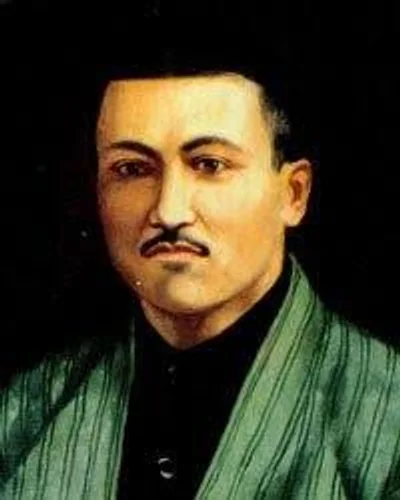
Abdulla Qodiriy was born in Tashkent in 1894. He studied in both traditional and Russian-native schools and worked as a clerk before turning fully to writing. He took a form that did not exist in Uzbek and made it work on the first attempt: O'tgan kunlar (Bygone Days), serialised from 1922, was the first full-length Uzbek novel, and Mehrobdan chayon followed. He also wrote a great deal of satire, much of it aimed at officials of exactly the kind the new state was producing. He was arrested in late 1937 and executed on 4 October 1938.
Childhood
Abdulla Qodiriy was born on 10 April 1894 in Tashkent, into a gardener's family. His father, Qodirmuhammad, had been a soldier under the khans and beks in his youth, then kept a shop in the Eski Joʻva market selling silk, household goods and tea, travelling to distant cities for his trade. Around 1870 he bought land in the Eshonguzar neighbourhood by the Samarkand Gate and became a gardener. Married four times, he was about fifty when he married Josiyat Bibi, then fifteen or sixteen. Their son Rahimberdi was born in 1879, but the twelve children after him died; the family moved to the garden by the Samarkand Gate, and there Abdulla was born, followed by a brother, Qudratilla, in 1897. Qodirmuhammad lived to 103 and died on 5 April 1924.
From his elder brother, a carpenter, Abdulla learned to carve wooden bowls and trays. As a boy he was lively and full of mischief.
Education
His father could barely read, but was determined his sons should: “If only I had known how to write,” he used to say, “I could have had you all dancing on my finger.” Abdulla studied from 1904 to 1906 with Mulla Olim and Mulla Ziyo domla in Zangi Ota, then with Yusufxon domla and with Mulla Gʻulom near Chorsu. From 1908 to 1912 he attended the “7th Russian-native school” near the Samarkand Gate; in 1916–1917 he studied Arabic and Persian at the Abulqosim Shayx madrasa, mastering Arabic grammar. In 1924–1925, with the help of the Tashkent waqf department, he studied at the Valery Bryusov literary institute in Moscow.
Work
Because the family was short of money, he began working for a rich man at twelve. At seventeen or eighteen he became a shop assistant to the Chorsu merchant Rasul Muhammadboy, and stayed three or four years, until the business failed in 1915 and he went home to carve wood with his brother, labour by the day and work in the garden.
After 1917 he entered state service: secretary of the Old City food committee (1918), editor of the newspaper Oziq ishlari (1919), secretary of the trade union council (1920). He wrote for Ishtirokiyun and Qizil bayroq, and from 1923 to 1926 was one of the founders and editors of the satirical magazine Mushtum.
Writer
His literary life began in 1913–1914 in the Jadid press, with poems of enlightenment such as “Ahvolimiz” (“Our Condition”), “Millatimiz” (“Our Nation”) and “Toʻy” (“The Wedding”). In 1915, inspired by Behbudiy's Padarkush, he wrote the play Baxtsiz kuyov (“The Unhappy Bridegroom”), and then the story Juvonboz, which he called a “national novel”. He used more than thirty pen names — Julqunboy, Dumbulboy, Kalvak Mahzum, Shilgʻay and many more — for his sharp satire.
Between 1919 and 1920 he finished Oʻtkan kunlar (“Bygone Days”), the first Uzbek novel, published in full in 1926. In 1928 came Mehrobdan chayon (“Scorpion from the Altar”), and in 1934 the novella Obid ketmon. He also translated Shunosiy's Physics from Tatar (1925), Gogol's The Marriage (1935) and Chekhov's The Cherry Orchard (1936).
Family
In 1914 Qodiriy married Rahbarnisa, the daughter of the merchant Rasul Muhammadboy; she died on 6 March 1943. They had five children: Nazifa (1916), Habibulla (1918), Adiba (1924), Masʼud (1926) and Anisa (1928). Habibulla was arrested in 1945 and spent ten years in prison; freed in 1955, he graduated from the Tashkent medical institute, worked as a doctor and became a writer himself, publishing the memoir Otam haqida (“About My Father”, 1974); he died in 1987. Masʼud also became a doctor and lived to see independence.
The family's garden house by the Samarkand Gate was taken in 1945 for a children's home and later given to a horse-breeding cooperative. It was returned to the family only in 1958, and is now a museum run by his grandson Hondamir Qodiriy.
The 1926 trial
On 8 March 1926 Qodiriy was arrested over his article “Yigʻindi gaplar” (“Odds and Ends”) in Mushtum. His house was searched and his letters and books confiscated. Held for two weeks without questioning, he threatened a hunger strike, and was finally interrogated on 24 March. He was accused of publishing the article against the editor's orders, of mocking the leaders of the Uzbek government and Communist Party, and of counter-revolutionary intent. He signed: “I do not admit my guilt.”
The case grew as the investigators added charges. In June he was taken under guard to Samarkand; after three days in court, on 15–16 June, he was sentenced to two years' imprisonment, and on 17 June the Presidium of the Central Executive Committee released him under an amnesty.
Arrest and death
On 31 December 1937 Qodiriy was arrested again, as an “enemy of the people”, and on 4 October 1938 he was shot in Tashkent. His books were then hunted too: Obid ketmon was condemned as full of “ideological errors”, and his historical novels — with their love of the homeland, of freedom and of justice — were declared harmful. Even readers of his novels were persecuted.
Recognition
After independence Qodiriy was awarded the Alisher Navoi State Prize (1991) and the Mustaqillik (Independence) Order (1994), and a state prize was named after him. The Tashkent Institute of Culture, a park and one of the city's main streets bear his name. Oʻtkan kunlar and Mehrobdan chayon were filmed in 1969, 1973 and 1996, and in 2018 a creative school and museum named after him opened in Tashkent.
Key achievements
- Wrote O'tkan kunlar (1925–26), the first Uzbek novel
- Wrote Mehrobdan chayon, a second major historical novel
- Executed in 1938 and formally rehabilitated after independence