
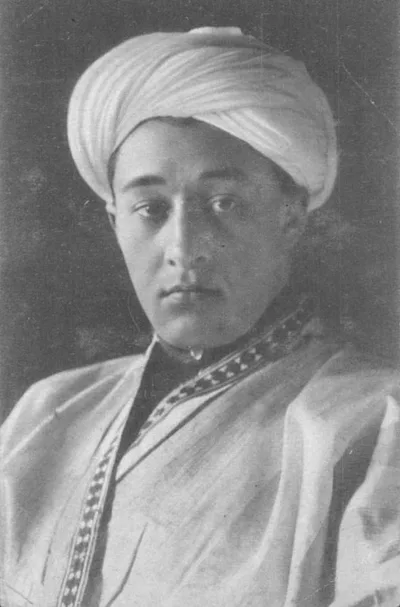
Fayzulla Xo'jayev was born in Bukhara in 1896 into a wealthy merchant family. He studied in Moscow as a teenager and came home committed to reform, becoming a leading figure among the Young Bukharans and using his family's money to fund schools and political work. After the Emirate fell in 1920 he headed the government of the Bukharan People's Soviet Republic, and from 1925 to 1937 chaired the Council of People's Commissars of the Uzbek SSR. He was arrested in 1937, tried in the Moscow show trial of 1938, and executed.
A merchant's son
Fayzulla Xo'jayev was born in Bukhara in 1896, the son of Ubaydullaxoʻja, one of the richest merchants in the city. In 1907 his father sent him to Moscow, where he studied until 1912, and he came home convinced that Bukhara had to change.
His position among the Jadids was unusual: most of them argued for reform from poverty, while he could pay for it. He used the wealth he inherited from his father to open new-method schools and to fund the political work of the Young Bukharans, and he soon became one of the party's leaders.
From emirate to republic
The Young Bukharans first hoped for a constitutional emirate. When the Emir answered them with arrests and executions, they wanted no emirate at all. In March 1918, when Fyodor Kolesov, chairman of the Turkestan Council of People's Commissars, attacked Bukhara, Xo'jayev and his associates took his side, and after the fighting the Emir hunted the Jadids down as traitors.
In 1920, with the support of the Red Army, the Emirate fell, and Xo'jayev — twenty-four years old — found himself at the head of the government of the new Bukharan People's Soviet Republic. Democratic reforms followed within a short time. One of the government's priorities was ordinary living conditions: it paved Bukhara's streets and improved its roads, and urban life began to change.
Schools and hospitals
Setting up new-method schools was among the most important things Xo'jayev did for enlightenment and science. As supporters of the Jadid movement, he and his associates set out to modernise the traditional system of education and give the young generation new scientific and cultural knowledge.
The schools he founded differed from the traditional madrasas in both method and subject: modern sciences, foreign languages and new teaching methods entered the curriculum, and teachers too had the chance to learn modern knowledge and improve their craft. Medical equipment was brought from Berlin and Moscow, and hospitals gained new departments, including X-ray rooms and eye clinics.
Abdurauf Fitrat, then teaching and writing in Tashkent, came to Bukhara at Xo'jayev's invitation and made a major contribution to these reforms, and a historic decision was taken to found the Bukhara People's University.
Students for Germany
The country clearly needed specialists with higher education. But at the new Turkestan State University in Tashkent, the Uzbek teachers led by Munavvar Qori Abdurashidxonov had been pushed out, and obstacles for local young people kept growing.
In this difficult period, enlightened intellectuals joined forces and, with the support of the Koʻmak society in Tashkent and of the Bukharan People's Republic, sent more than fifty talented young people to study in Germany. Munavvar Qori, Abdurauf Fitrat and above all Fayzulla Xo'jayev led the effort.
Head of the Uzbek republic
When the Uzbek SSR was created in 1924, Xo'jayev became the head of its government, and he governed the republic for thirteen years. He spent them trying to bend Soviet policy to local conditions — arguing over cotton quotas, irrigation and the pace of collectivisation — while doing what he could to protect Uzbekistan's interests and deal with its economic and social problems.
Arrest and execution
His fate in the end was the fate of many who shared his ideas. Arrested in 1937, he was accused of belonging to an anti-Soviet “right-Trotskyist bloc”, of leading a secret organisation called Milliy Ittihod, of supporting the Basmachi movement and its commanders, and of showing concern for and protecting Uzbek intellectuals such as Fitrat, Choʻlpon and Abdulla Qodiriy.
In March 1938 he stood in the last great Moscow show trial, alongside Bukharin and Rykov, and was shot the same month. Like everyone branded an “enemy of the people”, he did not suffer alone: his family and children were also falsely accused and made to pay. He was rehabilitated in 1966.
The house museum
To keep the memory of this statesman alive, the house in Bukhara where he lived was opened as the House-Museum of a Wealthy Merchant's Family, under a Cabinet of Ministers resolution on state museums to be reorganised between 2017 and 2027. A later government decision renamed it the Fayzulla Xo'jayev House Museum. Today it holds more than 500 exhibits.
The Jadid legacy
President Shavkat Mirziyoyev has signed a decree founding the State Museum of Jadid Heritage, and it is no accident that it is being set up in Bukhara, in the historic Hovli Poyon complex on Xoʻja Gulrez Street. Its purpose is to introduce young Uzbeks to the legacy of their Jadid forebears, to show their true place in the history of the country and the world, and to explain how they laid the spiritual foundations of independence. New archival sources are being studied to that end.
The Jadid movement in Turkestan, Khorezm and Bukhara produced a number of statesmen, and the lives of figures born in this land — Ahmad Donish, Abdurauf Fitrat, Fayzulla Xo'jayev, Sadriddin Ayniy — are still an inspiration. Uzbek has a word for people like Xo'jayev: maʼrifatparvar, someone who struggles for enlightenment and spreads knowledge. Working in extremely difficult conditions, he did much to raise his nation's spirit and defend its dignity, and in New Uzbekistan his ideas about knowledge and education remain as relevant as ever.
Key achievements
- Led the Young Bukharans and helped bring down the Emirate of Bukhara in 1920
- Headed the government of the Uzbek SSR for thirteen years, from its creation in 1924 until 1937
- Funded new-method schools and reformist publishing from his family's fortune