
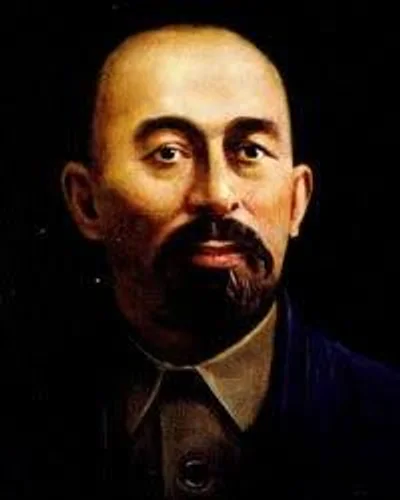
Abdulla Avloniy was born in Tashkent in 1878. Despite a difficult childhood he studied hard and became a leading teacher and writer. He opened new-method schools, wrote the textbooks Birinchi Muallim (The First Teacher) and Turkiy Guliston yoki Axloq (A Turkic Rose Garden, or Ethics), and founded newspapers. He also organised one of the first Uzbek theatre troupes and wrote plays attacking ignorance and harmful custom. He continued educational work through the 1920s and died in Tashkent in 1934 — one of the few of his generation to die of natural causes.
Childhood and family
Abdulla Avloniy was born on 12 July 1878 in the Mergancha neighbourhood of Tashkent. His grandfather, Mirneʼmatboy, came from Kokand, from a family of archers. His father, Miravlon aka, was a small craftsman and weaver who sold cotton and printed cloth at Piyonbozor — where the Navoi Theatre stands today — and at the Yarmarka market; he died in 1900. His mother's name was Fotima. That same year Avloniy married Salomatxon, the daughter of a Tashkent merchant family.
Education
At seven he learned to read and write at the old-style school in Oʻqchi under Akramxon domla. In 1890 he entered the neighbourhood madrasa, and later studied at the Abdumalikboy madrasa in Shayxontohur under Mulla Umar Axund. From 1891 he studied only in winter and worked as a labourer the rest of the year, learning the building trades — brickmaking, plastering, stove-making and carpentry.
A school and a newspaper
In 1904 Avloniy opened a new-method school in Mirobod. It became famous across Tashkent, but the colonial authorities watched every such school — its teachers, pupils, curriculum and textbooks — and in 1908 it was closed. “When the ignorant people of Mirobod learned that I was holding lessons about the earth, people, mountains, rivers and sky,” he later wrote, “they called me an unbeliever and closed my school.” In 1909 he opened another in the Degrez neighbourhood, and there saw that the new schools needed textbooks of their own.
In 1907 he began publishing the newspaper Shuhrat from his own home; after ten issues it was closed and its press, paper and equipment confiscated. He then published Osiyo under the name of Bektemirov, from his house at 26 Sapyornaya Street, and in 1914–1915 wrote many of the poems and articles in Sadoyi Turkiston, edited with the lawyer Ubaydulla Xoʻjayev, until money ran out after 66 issues. In 1909 he also founded the Jamiyati xayriya (Charitable Society), which collected money to send poor children to school.
Theatre
At the end of 1913 Avloniy was among the founders of the Turon society, whose theatre troupe opened with Behbudiy's Padarkush. He worked with the Tatar director Zaki Boyazidskiy and the Azerbaijani actor Sidqi Ruhillo, who came to Tashkent at his invitation in 1916 to stage Layli and Majnun and played Majnun himself. On 26 December 1914 the troupe set off on a tour of the Fergana Valley as Turkiston, playing Kokand on 7 January 1915, Namangan from 21 to 24 January and Osh on 29 January.
In 1915 local people drove him out of his school, calling him a “theatre man” and a “clown”, and the authorities pressed him too. He went on to help found the Nashriyot and Maktab societies, which aimed to unite the young people of Turkestan politically.
1917 and after
After the February Revolution Avloniy published the newspaper Turon under the slogan “Long live the people's republic!”, promising to end the oppression and superstition that had weighed on Muslims for so long. When conservative clerics threatened the printers — they would not say funeral prayers for anyone who printed it — the paper was isolated; he brought type and a typesetter from the Molla Nasreddin press in Tiflis, but was still not allowed to print it. That year he founded the Teachers' Union and several workers' unions in Tashkent, served on the Old City food commission, and in August attended the Second Congress of All-Russian Muslim Teachers in Kazan.
In 1918 he joined the Communist Party, chaired the Old City executive committee, and was elected to the Central Committee of the Communist Party of Turkestan and, in 1919, to the Central Executive Committee of Turkestan; he also co-edited the newspaper Ishtirokiyun. From September 1919 to July 1920 he was consul general in Herat, Afghanistan — a posting that deepened his doubts about the Bolsheviks, whom he came to see as no different from the Tsarist generals. Recalled because of ill health, he headed the cultural department of the Turkbyuro and edited Kasabachilik harakati.
Teacher and professor
From 1921 Avloniy devoted himself to education: he directed the regional education institute in Tashkent, in 1923 the Tashkent Women's Education Institute, and in 1924 taught at a military school. From 1925 to 1930 he taught at the Central Asian Communist University and the Central Asian Agricultural School, and later became a professor and head of the Department of Language and Literature in the Faculty of Pedagogy of the Central Asian State University.
Poet and playwright
Avloniy began writing poems in 1894; the earliest are lost. His four-part collection Adabiyot yoxud milliy sheʼrlar (“Literature, or National Poems”) was published several times between 1909 and 1917. He signed his poems Hijron, and his articles Mulla Abdulla, Avloniy or Indamas; after 1917 he wrote satirical poems and humorous stories, many for the magazine Mushtum, under pen names such as Nabil, Shuhrat, Tangriquli, Surayyo, Chegaboy and Abdulhaq.
For the stage he wrote Advokatlik osonmi?! (“Is it easy to be a lawyer?!”), Pinak, Biz va siz (“We and You”), Ikki sevgi (“Two Loves”, about the Young Turk Revolution) and Portugaliya inqilobi (“The Portuguese Revolution”, 1921), and translated plays from Tatar and Azerbaijani. None of his plays were published in his lifetime.
Textbooks
His school books were reprinted many times between 1909 and 1917 and used in new-method schools across Turkestan:
- Birinchi muallim (“The First Teacher”)
- Ikkinchi muallim (“The Second Teacher”)
- Turkiy guliston yoxud axloq (“A Turkic Rose Garden, or Morals”)
- Maktab gulistoni (“The School Rose Garden”)
- Muxtasar tarixi anbiyo (“A Short History of the Prophets”, 1910)
In 1933 he compiled a reader for seventh-grade pupils with the lives and work of dozens of Uzbek writers of the 1920s and 1930s, alongside Russian and European authors.
Death
Abdulla Avloniy died on 25 August 1934, before the purges of 1937–38 that took most of his friends. Many of his manuscript poems from the Soviet years were rediscovered only in the 1960s.
Key achievements
- Wrote Turkiy Guliston yoki Axloq (1913), the first systematic Uzbek work on ethics and pedagogy
- Founded and taught in new-method schools in Tashkent for over three decades
- Organised one of the first Uzbek theatre troupes and wrote plays for its repertoire