
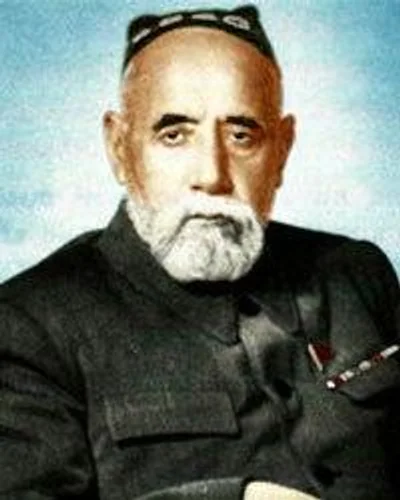
Sadriddin Ayniy was born in 1878 in a village near Bukhara. Orphaned young, he studied in the city's madrasas and joined the Jadid movement, which cost him a public flogging by order of the Emir in 1917. He wrote in both Tajik and Uzbek and became a major figure in each literature. His novels Dokhunda, Ghulomon (Slaves) and Margi sudkhur (Death of the Usurer), together with his multi-volume memoirs, are classics. Unlike most of his generation he survived the purges, later became the first President of the Academy of Sciences of Tajikistan, and died in 1954.
Childhood and education
Sadriddin Ayniy was born on 15 April 1878 in the village of Soktare, in the Gʻijduvon district of the Emirate of Bukhara, to Saidmurodxoʻja and Zevaroy. He started at the village school at six, and at twelve came to Bukhara, where he studied for ten years.
He moved through the city's great madrasas: Mir-i Arab (1890–1891), Olimjon (1892–1893), Badalbek (1894–1896), Hoji Zohid (1896–1899) and Koʻkaldosh (1899–1900). There he fell in with progressive young intellectuals such as Hayrat and Abduqodir Maxdum.
A new school in Bukhara
Inspired by the school of Abduqodir Shakuriy, Ayniy, Munzim, Ahmadjon Hamdiy and Hamidxoʻja Mehriy opened a Jadid school on 23 October 1908, in Mirzo Abdulvohid Munzim's house in the Darvozai Sallohxona quarter of Bukhara. It taught in Persian (Tajik).
At the time Ayniy was also assistant at the school of Nizom Sobitiy, a Tatar intellectual working in Bukhara, and came to know Sirotul Mustaqim (“The Straight Path”), a Turkish social, religious, scientific and literary journal that the teacher Abdurahmon Saʼdiy read regularly.
Textbooks and societies
A new school needed textbooks, manuals and reading matter, so in March 1909 its founders set up the Shirkati Buxoroyi Sharif, the Noble Bukhara Company. It had nine members: Abdulvohid Munzim, Sadriddin Ayniy, Ahmadjon Maxdum (Hamdiy), Aminjon Maxdum, Usmonxoʻja Poʻlatxoʻjayev, Hamidxoʻja Mehriy, Mulla Nizom Sobitiy, Abdurahmon Saʼdiy and Mirzo Abdulqodir Muhiddinov.
Through it Ayniy published several books for Jadid schools in 1909, among them Tartil ul-Qurʼon, on the rules of reciting the Qurʼan, Zaruriyoti Diniya (The Necessities of Religion) and Tahsib us-Sibyon (Children's Education), so that pupils finally had textbooks of their own.
The school quickly won people's respect, but Bukhara's conservative clergy opposed it, and in 1909 the government closed it. That same year Ayniy and Munzim took the lead in founding the Tarbiyayi Atfol (Education of Children) society; of its 28 members, fourteen were chairmen, judges, madrasa teachers, mullahs and mullahs' sons.
Seventy-five lashes
As pressure for reform and for a democratic order grew in Russia, Emir Sayyid Olimxon signed a reform decree on 7 April 1917. The Young Bukharans met to discuss it at the house of Halim Ashurov in the Bozorgul quarter, joined by Jadids from Samarkand including the mufti Mahmudxoʻja Behbudiy and Qori Haydarbek.
Ayniy, Munzim, Fazliddin Maxdum, Muhiddin Rifʼat, Mirzashoh, Mirza Izatullo and Hamidxoʻja Mehriy were against holding a demonstration, and Behbudiy agreed with them. But the Jadids led by Abdurauf Fitrat went ahead, gathering on 8 April to thank the emir. The emir ordered the demonstration stopped as a threat to order in the capital, and its participants arrested and punished.
Ayniy had not taken part, but he was arrested on 9 April all the same and given 75 lashes. Released after the Provisional Government intervened, he spent 52 days in hospital in Kogon, then left for Samarkand.
Samarkand and Tashkent
In Samarkand Abduqodir Shakuriy gave him a place to live and introduced him to enlightened intellectuals such as Saidrizo Alizoda, Siddiqiy Ajziy, Saidahmad Vasliy and Vadud Mahmud. From then on Ayniy kept away from politics and gave himself to scholarship and literature.
In March 1918 Fyodor Kolesov, chairman of the Turkestan Council of People's Commissars, attacked the Emirate of Bukhara, and Fayzulla Xoʻjayev and his associates sided with him. When the fighting ended the emir turned on the Bukhara Jadids as traitors and began killing them, and the Young Bukharans scattered across Turkestan. When his men reached Samarkand too, Ayniy fled to Tashkent.
On 22 October 1918 he returned to Samarkand to teach Uzbek and Tajik literature and history at a school, and in 1919 took a senior post in the Samarkand department of education. In June 1920 Fayzulla Xoʻjayev, leader of the Young Bukharans, called him to Tashkent, where he drafted projects, statements and other documents for the Bukhara communist organisation in both Tajik and Uzbek.
Scholar and academician
From 1921 to 1923 Ayniy was an adviser at the consulate of the Bukharan People's Soviet Republic in Samarkand. When it closed he ran Bukhgostorg, the Bukhara trading house, in Samarkand until 1925. On 15 June 1926 he became editor and scientific and literary consultant at the new Tajik State Publishing House in Samarkand, and stayed until September 1933.
In 1939 he was elected a deputy of the Dushanbe city soviet. When the Academy of Sciences of the Uzbek SSR was founded on 4 November 1943 he was elected an academician; from 1946 to 1950 he headed the department of Uzbek literature at Samarkand State University; and in 1951, when the Academy of Sciences of Tajikistan was established, he became its first president.
Poet, journalist and translator
Between 1890 and 1895 he wrote poetry under pen names such as Sifliy, Muhtojiy and Jununiy, and from 1896 as Ayniy. In 1919 he wrote Soli Naxustin (The First Year), a primer for primary pupils.
From 1918 to 1920 he wrote for the Tajik-language Shuʼlai Inqilob (The Flame of Revolution), Bolalar Yoʻldoshi and Tayoq, and for the newspapers Mehnatkashlar Tovushi, Zarafshon and Hurriyat. Shuʼlai Inqilob alone printed 67 of his articles, signed Sin Mim, Qof-Sin, Sin Xo, Sin, Xo, Sin Qof, Sod Ayn and Sod Ayniy, and more than 30 of his poems and pieces. For his satire in Tayoq, Mehnatkashlar Tovushi and elsewhere he signed himself Sarson, Furtakigoʻy, Tolesiz, Azgʻich, Tayoq, Zimgʻoyib, Buzina, Battol and Roʻzador.
In 1925 he edited the Uzbek translation of Abu Tohirxoʻja's Samariya, made in 1921 by the local historian Abdulmoʼmin Sattoriy, who had died of tuberculosis on 23 July 1925; Ayniy corrected it and wrote a preface and a glossary of terms. It was never published, and the prepared manuscript is kept at the Abu Rayhan Beruni Institute of Oriental Studies. He also translated Ferdinand Duchesne's Hilol (The New Moon), publishing it as Qamar, M. Bulle's Women in Revolutionary Struggles and Victor Hugo's The Enchanted Palace into Uzbek.
Major works
Ayniy's scholarly and literary works include:
- History of the Manghit Emirate of Bukhara (1921)
- The Executioners of Bukhara (1922)
- Odina
- The Girl, or Kholida (1924)
- Examples of Tajik Literature (1926)
- Qul Bobo, or Two Freed Men (1928)
- Doxunda (1927–1929, in Tajik)
- Qullar (Slaves, 1934, in Uzbek)
- On Ferdowsi and His Shahnameh (1934)
- The Old School (1935)
- The Death of the Moneylender (1939)
- Sheikh al-Raʼis Abu Ali ibn Sina (1939)
- Ustod Rudaki (1940)
- Sheikh Muslihiddin Saʼdi Shirazi (1942)
- Alisher Navoi (1948)
- Memoirs, in four parts (1949–1954)
Between 1936 and 1938 he also compiled a dictionary of the Tajik literary language of about fifteen thousand words.
Family and death
Ayniy married the sister of the Samarkand Jadid intellectual Vadud Mahmud. They had two children: a daughter, Kholida, and a son, Kamol.
Sadriddin Ayniy died in Dushanbe on 15 June 1954, at the age of 76.
Key achievements
- Wrote foundational novels in both Tajik and Uzbek, including Margi sudkhur (Death of the Usurer)
- His multi-volume Yoddoshtho (Memoirs) is a primary source on life in the Emirate of Bukhara
- Became the first President of the Academy of Sciences of Tajikistan