
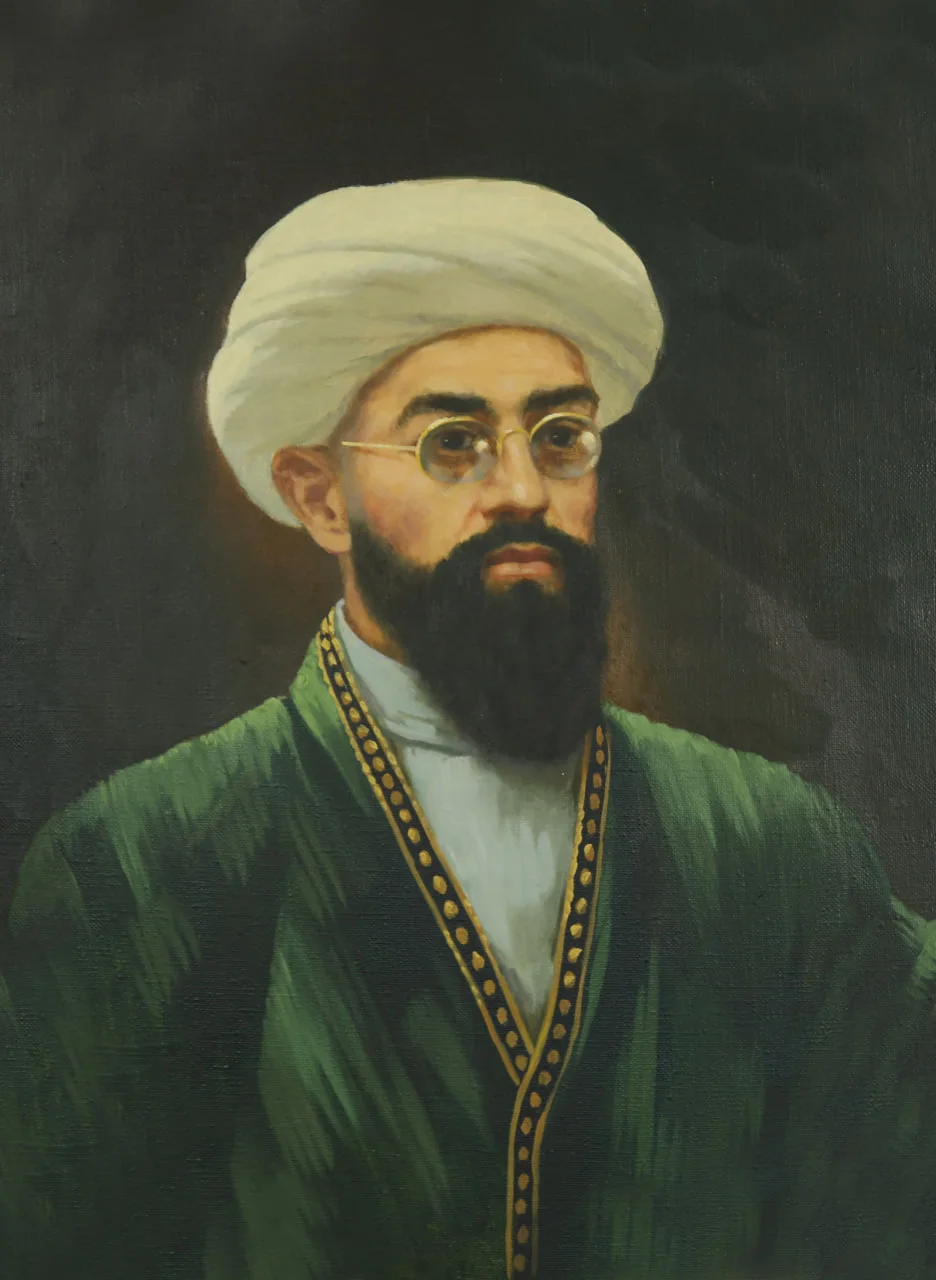
Born near Samarkand in 1875 into a family of religious scholars, Behbudiy received a traditional education and became a mufti. Travels to Istanbul, Cairo and the Hejaz in 1899–1900 showed him how far the Muslim world beyond Turkestan had already moved, and he returned determined to modernise education at home. He opened new-method schools, published newspapers and the magazine Oyna (The Mirror), and wrote Padarkush (The Patricide), the first modern Uzbek play. He was arrested by the Emir of Bukhara's men and executed at Qarshi in 1919.
Childhood
Mahmudxoʻja Behbudiy was born on 19 January 1875 in the village of Baxshitepa near Samarkand. His father, Behbudxoʻja Solihxoʻja oʻgʻli, was a descendant of Ahmad Yassaviy and worked as an imam and preacher. His mother, whose name is not known, died in 1893, and his father in 1894.
Education
Mahmudxoʻja grew up in the care of his uncle, the judge Muhammad Siddiq, and learned Arabic grammar from his younger uncle, Mulla Odil. Lack of money kept him from completing his studies at the madrasas of Bukhara.
Career
Back in Samarkand he began as a scribe (mirzo) in his uncle's court and later rose to the rank of mufti. In 1899–1900 he made the Hajj. On his return he studied the reasons for the region's decline and discussed them with like-minded men such as Baqo Hoji, Hoʻqandboy Abduxoliq oʻgʻli and Badriddin. In 1903, on his initiative, his students Siddiqiy-Ajziy and Abduqodir Shakuriy opened new-method schools in the village of Rajabamin, and Hoji Muin opened one in the Xoʻja Nisbatdor quarter.
In 1908 he opened a reading room, the Qiroatxonayi Behbudiya, later known simply as the Behbudiya library. It worked in two shifts — from nine in the morning to five in the afternoon, and from six in the evening until midnight — and served between 60 and 110 readers; by Behbudiy's own account it held some 600 books and pamphlets as well as newspapers and journals. On a journey in 1914 through the Caucasus, Crimea, Turkey, Egypt, Greece, Bulgaria, Austria and Germany he brought back many more books for it.
Newspapers and a journal
In April 1913 Behbudiy launched the newspaper Samarqand, and in August the journal Oyina. Samarqand came out twice a week in Uzbek and Tajik, first in two pages and later four; after its 45th issue, on 17 September 1913, colonial censorship and lack of money closed it.
Oyina was a weekly with articles in both Uzbek and Tajik, and its subscribers lived not only in Turkestan but in the Caucasus, Tatarstan, Iran, Afghanistan, India and Turkey. Until 1915 it published important debates on the rights of the people of Turkestan, on history, language and literature. Language mattered most to its editor: Behbudiy believed that knowing several languages was essential to a nation's progress. Fitrat, Siddiqiy, Hoji Muin, Akobir Shomansur, Saidrizo Alizoda, Vasliy, Tavallo, Sadriddin Ayniy, Niyoziy Rajabzoda and many others wrote for it, and it served as a training ground for young writers and future teachers.
The colonial authorities watched it closely. The National Archive of Uzbekistan holds a letter of 19 August 1914 from the chief of staff of the Turkestan Military District ordering Samarkand's publications to be monitored, because “articles contrary to Russian interests might appear in the local press” during the war; Behbudiy was summoned and made to sign that he had read the secret order. He kept answering his critics, but in 1915 the journal was forced to close.
Padarkush and the birth of Uzbek theatre
Behbudiy wanted a national theatre that would show people the vices and ignorance of their own society and call them towards progress. For it he wrote Padarkush (“The Patricide”), a short three-act “national tragedy” about an uneducated boy who falls into bad company and kills his own father. To get it past the censors in Tiflis, its cover said it was dedicated to the anniversary of the Battle of Borodino; it was published in 1913.
Padarkush was first performed in Samarkand on 15 January 1914 and in Tashkent on 27 February 1914, where Abdulla Avloniy's Turon troupe opened its career with it. Between 1914 and 1916 the troupe took it all over the Fergana Valley, and it stayed on the stage even in the bloodiest years that followed. It called the nation to enlightenment — and it marked the birth of Uzbek theatre and drama.
Political activity
When the February Revolution of 1917 overthrew the Tsar, the Jadids of Turkestan felt the wind of freedom. “God has given us freedom,” Behbudiy wrote. “The path is open for religious and national reform and progress.” In March 1917 a congress of the Muslims of Turkestan in Tashkent elected a national council that included him, and at the congress of 16–23 April he urged 150 delegates to end their quarrels and unite: “Because of our disunity they rule us according to colonial rules.”
That summer he proposed autonomy for Turkestan, governed together with the Russians, Jews and other peoples living there, with a consultative assembly of its own. After the Bolsheviks took power, the Fourth Extraordinary Congress of the Muslims of the Territory met in Kokand on 26 November 1917 and proclaimed the Autonomy of Turkestan, with Behbudiy among its founders. “I am proud that I was also present,” he wrote in the newspaper Hurriyat. “If all of Turkestan unites, a force of fifteen million will arise that will make the earth tremble.”
In February 1918 the Bolsheviks attacked Kokand and drowned the city in blood; the autonomy had lasted 72 days. Behbudiy did not join the Reds. Already in 1917 he had joined the secret society Ittihodi Taraqqiy, formed against them, which twice sent envoys to Turkey in search of help — both times without success.
Writings
Behbudiy wrote hundreds of articles for Turkiston viloyatining gazeti, Tujjor, Samarqand and Oyina on the nation and the homeland, society and morality. He also wrote textbooks and manuals, among them:
- Risolai asbobi savod (1904)
- Risolai jugʻrofiyai umroniy (1905)
- Risolai jugʻrofiyai Rusiy (1905)
- Kitobat ul-atfol (1908)
- Amaliyoti islom (1908)
- Tarixi islom (1909)
Family
He had four sons and a daughter. His eldest son, Maʼsudxon, was born in 1897; Maqsudxon (1910–1931) showed a gift for geography but died young; Matlubxon, born in 1914, went missing in the war; and Shavkat, born in 1919, died in 1990. His daughter Parvin (Surayyo) died in 1984, aged 82.
Death
In 1919, with the help of agents of the Cheka, Behbudiy was arrested in the Shahrisabz district, taken to Karshi some two months later and imprisoned. A few days after that, on the orders of the governor of Karshi, he was killed in the garden beside the prison by the governor's assistant, Nuriddinxoʻja Ogʻaliq. News of his death reached Samarkand only a year later; Fitrat, Choʻlpon, Sadriddin Ayniy and other poets wrote elegies for him.
His pupils and friends formed a Samarkand commission to find his grave and his killers, but Nuriddin Ogʻaliq, who had kept a high post under the new government, blocked them. In the autumn of 1923 an inspection by the Bukharan People's Soviet Republic accused him of embezzling 42,000 poods of state wheat and 20,000 gold coins, of forcing hundreds of half-starved labourers to work his land — and of causing the death of Behbudiy. He was shot on 19 September 1923 on the Registan in front of 5,000 people.
That October the congress of the Bukharan Republic renamed Karshi Province as Behbudiy Province. It kept that name until 1937, when the purges removed his name from the map. His grave has never been found.
Key achievements
- Wrote Padarkush (1911), the first modern Uzbek play, and staged it in Samarkand in 1914
- Founded the magazine Oyna and the newspaper Samarqand, cornerstones of the Turkestan press
- Opened new-method schools and wrote the textbooks they taught from