
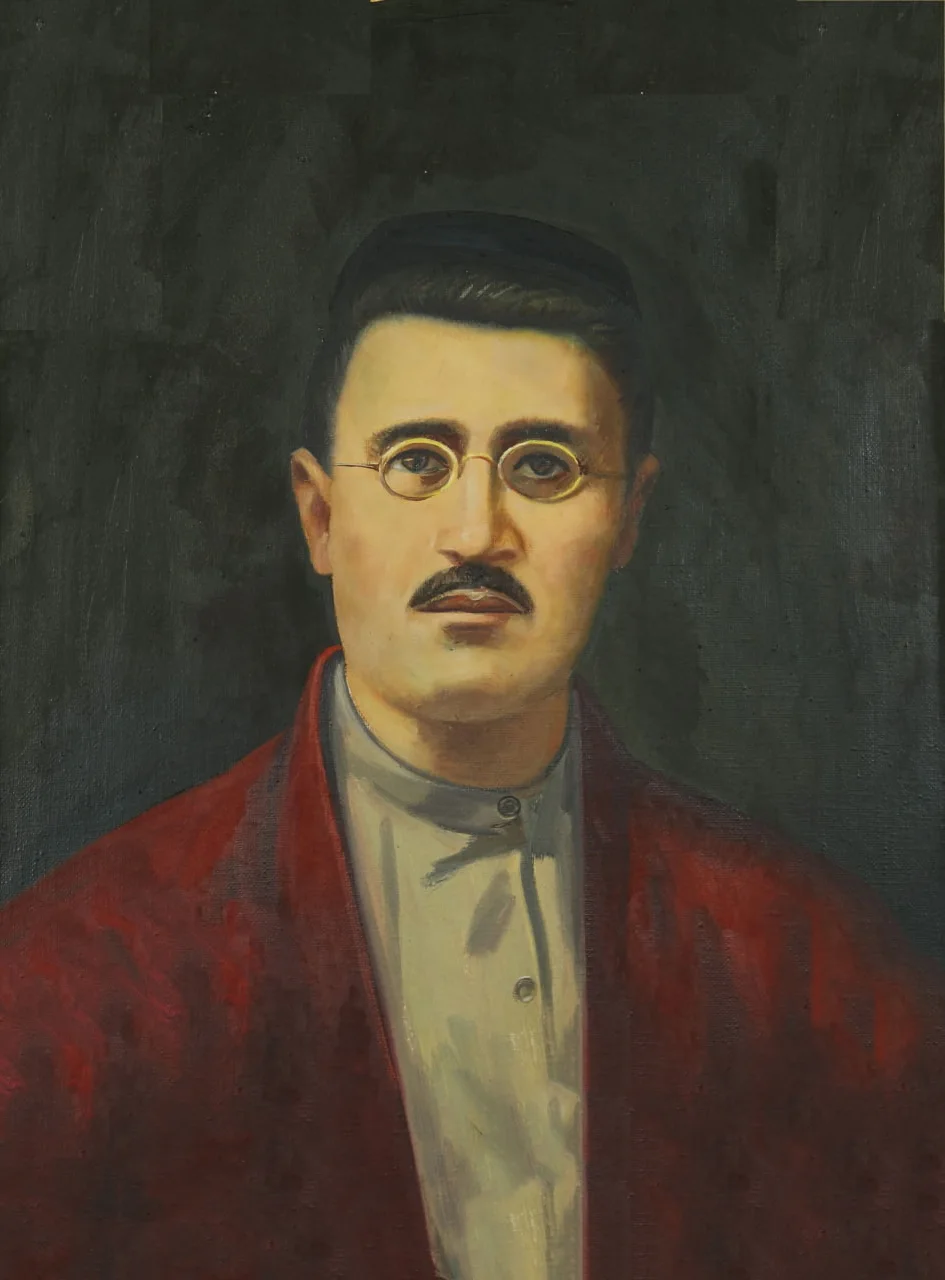
Cho'lpon — the pen name means "morning star" — was born Abdulhamid Sulaymon o'g'li Yunusov in Andijan in 1897. He studied in both traditional and Russian-native schools and was publishing poetry and journalism in his teens. He pulled Uzbek lyric verse out of classical convention into something recognisably modern, writing in a plain personal voice about longing and the state of his country. His collections Uyg'onish, Buloqlar and Tong sirlari shaped modern Uzbek poetry; he also wrote the novel Kecha va kunduz and translated Shakespeare. He was arrested in 1937 and executed on 4 October 1938.
Childhood
Abdulhamid Choʻlpon was born in 1897 in the Qatorterak neighbourhood of Andijan — around today's Navoi Avenue — into a comfortable family. His mother, Oysha aya, knew Uzbek folk literature well, and his love of words began with her lullabies and stories. Of her fourteen children only four survived; Abdulhamid was the eldest, followed by his sisters Komila (born 1902), Fozila (1905) and Foyiqa (1908).
His father, Sulaymonqul Yunus oʻgʻli, originally from Yorqishloq near Osh, was an educated man who farmed, worked as a craftsman and later traded in cloth; he read Eastern literature and wrote poetry under the pen name Rasvo.
Education
Abdulhamid studied at a local school and then at madrasas in Andijan and Tashkent, where besides the Quran and Islamic law he learned Arabic, Persian and Turkish — later he wrote some poems in Ottoman Turkish. His student years coincided with the Russian Empire's drive to russify Turkestan, with news of the 1905 revolution and of events in Iran and Turkey, and with the rise of the Jadids. The work of Behbudiy, Munavvar Qori, Ibrat and above all Fitrat drew him in; Choʻlpon later wrote that Fitrat inspired young Uzbek writers to reform poetry and write in the living language of the people rather than in borrowed Arabic and Persian forms.
First writings
His work began appearing in the Turkestan press in 1912–1913, under the pen names Qalandar, Mirzaqalandar, Andijonlik and, finally, Choʻlpon (“the morning star”). His early pieces in Turkiston viloyatining gazeti, Sadoyi Turkiston, Sadoyi Fargʻona and the journals Shoʻro and Oyina preached enlightenment and described plainly the hard lives of people oppressed from every side. After 1916 social and political themes took over, and his articles in Fitrat's Hurriyat in 1917 dealt with the burning questions of the day.
Orenburg, Tashkent, Baku, Bukhara
In 1917–1919 he went to Orenburg with Ubaydulla Asadullaxoʻjayev and others, worked as secretary to the chairman of the Bashkir government and wrote on the future of the Turkic peoples for Shoʻro. There in 1918 he met Mannon Uygʻur's touring theatre troupe from Tashkent, and the theatre became part of his life.
Back in Tashkent in 1919–1920 he wrote for Ishtirokiyun, and at Nazir Toʻraqulov's invitation worked for Yangi Sharq in Fergana. In September 1920 he attended the Congress of the Peoples of the East in Baku, with Munavvar Qori and other Turkestan intellectuals. In 1921, at Fitrat's invitation, he edited Axbori Buxoro, spreading the Bukharan Jadids' views on science and society, until the campaign against the leaders of the Bukharan revolution sent Fitrat to Moscow and Choʻlpon back to Tashkent.
Moscow
In 1923 he worked for the newspaper Darxon in Andijan, then returned to Tashkent and the theatre. In 1924 he went to Moscow with 24 members of Uzbek theatre troupes sent to study there, as translator and literary assistant. He met Fitrat and Abdulhay Tojiyev, translated several works into Uzbek at their request, and began learning German — hoping to talk to the Turkestani students sent to study in Germany and to read German literature. Many of those students were later accused of spying and disappeared.
Poetry and prose
Choʻlpon published three major collections of poems — Uygʻonish (“Awakening”, 1922), Buloqlar (“Springs”, 1923) and Tong sirlari (“Secrets of Dawn”, 1926) — which made him the leading voice of modern Uzbek poetry. His novel Kecha va kunduz (“Night and Day”) portrays the hard life of the people, and of women above all. In stories such as “Jaholat qurboni” (“The Victim of Ignorance”), “Doktor Muhammadiyor”, “Novvoy qiz” (“The Baker Girl”), “Oydin kechalarda” (“On Moonlit Nights”) and “Qor qoʻynida lola” (“A Tulip in the Snow”) he exposed the ills of society. His journalism ranged from Turkestan's farming and railways to “What is literature?” and “Let our spirit not die!”.
Under pressure
From the late 1920s writers who wrote about the future of their nation were branded “nationalists”, “pan-Turkists” or “pan-Islamists”. By 1931 the pressure on Choʻlpon was so great that in 1932 he left for Moscow, returning two years later. Between 1935 and 1937 he translated the second part of Gorky's Mother and his Yegor Bulychov, Pushkin's Dubrovsky and Boris Godunov and Lahuti's Journey to Europe, submitted a poetry collection, Joʻr, and wrote for the theatre and for Mushtum. His application to the new Writers' Union of Uzbekistan was ignored, his work was kept out of print, and an appeal to Akmal Ikromov achieved nothing; even the propaganda poems he tried to write in the end were not published.
Family
In 1923 Choʻlpon married Soliha; they had no children and eventually divorced. In 1932, in Moscow, he married Yekaterina Ivanovna, and they lived together until his arrest.
Death
Choʻlpon understood that he would not escape the machine that was closing in on the nation's leading minds. He moved his manuscripts and personal papers from his home in Andijan to Tashkent. Soon afterwards he was arrested by the Soviet security service, and on 4 October 1938 Abdulhamid Choʻlpon was shot.
Key achievements
- Wrote Kecha va kunduz, a landmark of modern Uzbek prose
- Translated Shakespeare's Hamlet and works of Pushkin into Uzbek
- Executed in 1938; his poetry was banned for fifty years