
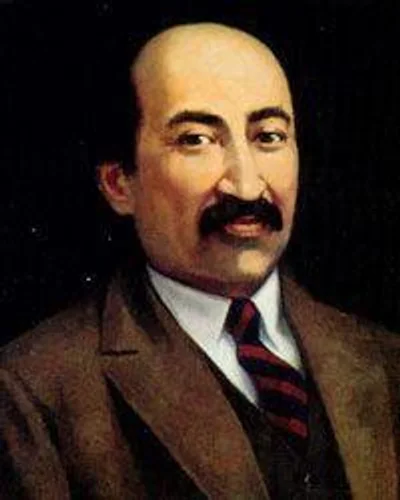
Abdurauf Fitrat was born in Bukhara in 1886. After studying in local madrasas he spent 1909 to 1913 in Istanbul, where his reformist thinking took its mature shape. He returned to write the movement's fiercest polemics, arguing that Bukhara's decline was the fault of Bukhara rather than of outsiders — a case that made him enemies on every side of it. He became a leading Young Bukharan and held ministries in the Bukharan People's Soviet Republic, then turned to scholarship in literature, linguistics and music. He was executed in the purges in 1938.
Childhood
Abdurauf Fitrat was born in 1886 in Bukhara, into the family of the merchant Abdurahimboy, who travelled on business to Turkey, Iran and Kashgar. His mother, Bibijon (Nastarin Bibi), was born around 1866. He had a younger brother, Abdurahmon, who worked as a typesetter at the Kogon printing house in the 1910s, and a sister, Mahbuba, who wrote poetry.
Education
He studied first at a traditional school and then at the Mir-i-Arab madrasa. With the support of the Tarbiyai atfol society he studied in Istanbul from 1909 to 1913. There he and his comrades founded a society to help students from Bukhara and Turkestan and to bring more of them to Turkey, and published its statute in 1909. He regularly sent Turkish journals such as Hikmat, Taʼrufi muslimin and Mehmet Akif's Sirot ul-mustaqim back to Bukhara.
From Bukhara to Tashkent
Back in Bukhara, from 1912 to 1916 he opened Jadid schools and taught in Bukhara and Karshi. From 1917 he was one of the ideologists of the Young Bukharans. When pressure from Emir Olimxon forced the Jadids out of Bukhara in April 1917, he moved to Samarkand and edited the newspaper Hurriyat (1917–1918).
In March 1918, when Kolesov's Red forces invaded the emirate, the Jadids led by Fitrat and Fayzulla Xoʻjayev sided with them; the furious emir set out to destroy them, and they fled to Tashkent. There Fitrat taught at a school in Xadra (1918–1919) and worked as a translator at the Afghan embassy (1919–1920).
Chigʻatoy gurungi
His most important work in Tashkent was the Chigʻatoy gurungi (“Chagatai circle”), a cultural and literary society active from 1919 to 1921 that began the serious study of the culture, literature, history, language and spelling of the Turkic peoples. It had sections for language and spelling (led first by Choʻlpon, later by Elbek), literature, and art and theatre; Qayum Ramazon, Elbek, Ashurali Zohiriy, Shorasul Zunnun and Akmal Ikromov were among its members.
In 1919 the circle reformed the Arabic script into a new alphabet, and in January 1921 it organised the Language and Spelling Congress in Tashkent. It collected rare manuscripts across the Fergana Valley, Bukhara and Samarkand, and brought to Tashkent a manuscript of Navoiy's Tarixi muluki ajam and portraits of the Timurids from Amir Temur to Akbar. The authorities closed the circle on 10 January 1921 — and when Fitrat and his students were arrested years later, membership of it was among the gravest charges.
Minister of the Bukharan Republic
After the Bukharan People's Soviet Republic was founded, Fitrat returned to Bukhara as People's Commissar of Education (1921), and in 1922 served as Commissar of Foreign Affairs, chairman of the Council of National Economy and deputy chairman of the republic's government. As education commissar he opened a School of Eastern Music in Bukhara and commissioned histories of the Ark, of the Bukharan revolution and of Central Asia.
In June 1923 Moscow's envoy Rudzutak had him removed and expelled from Bukhara, accused of nationalism, of “building roads instead of doing educational work”, and of corruption; a dozen of his colleagues were dismissed with him. From 1923 to 1926 he lived in Moscow and worked at the Institute of Oriental Studies, becoming a professor in 1926. From 1927 he lived in Samarkand and Tashkent, and from 1931 until his arrest headed a department at the Uzbekistan Institute of Language and Literature.
Poetry and drama
In the poem “Yurt qaygʻusi” (“Grief for the homeland”) and in his free verse he openly sang of the struggle for freedom, portraying Turkestan as a humiliated mother and calling on the spirit of Amir Temur to rouse the people. In “Mirrix yulduziga” (“To Mars”), “Sharq” (“The East”) and “Shoir” (“The Poet”) he voiced his hatred of the Bolsheviks who were turning Turkestan into a colony.
In Munozara (“The Debate”) and Hind sayyohi qissasi (“The Tale of an Indian Traveller”) he attacked the backwardness of Turkestan society, the neglect of science and the superstitions that had crept into Islam. From 1916 he wrote historical dramas — Begijon, Qon (“Blood”), Abu Muslim, Temur sagʻanasi (“Temur's Tomb”), Oʻgʻuzxon — and in Chin sevish (“True Love”, 1920) and Hind ixtilolchilari (“The Indian Revolutionaries”, 1923) moved Turkestan's tragedy to British India, so that his Indian freedom fighters were a portrait of his own compatriots.
Religion and society
His treatises include Rahbari najot (“The Path of Salvation”, in Persian), which explained Quranic commentary, hadith, law, theology and the secular sciences; Oila (“The Family”), on the sacred place of the family; Mavludi sharif; Oʻquv (“Education”); Sharq siyosati (“Eastern Politics”); Yigʻla, Islom (“Weep, Islam”); and Muxtasar islom tarixi (“A Short History of Islam”, 1925).
Language and literary scholarship
Fitrat laid the foundations of the scientific study of Uzbek grammar. With Qayum Ramazon and Shokirjon Rahimiy he wrote the textbook Ona tili (“Mother Tongue”, 1918), followed by volumes on morphology (Sarf, 1925) and syntax (Nahv, 1926), reprinted until 1930. In the 1920s he coined many new Uzbek words and terms from Old Turkic, the spoken language and the dialects.
He compiled the anthologies Eng eski turk adabiyoti namunalari (“Samples of the Oldest Turkic Literature”, 1927) and Oʻzbek adabiyoti namunalari (1928), studied all three manuscripts of Yusuf Khass Hajib's Qutadgʻu bilig, and was the first to write scholarly studies of Bedil, Navoiy's Persian poetry, Ahmad Yassaviy, Turdi, Muhammad Solih, Omar Khayyam, Mashrab and the Farhod and Shirin epic. With She'r va shoirlik (“Poetry and the Poet”, 1919), Adabiyot qoidalari (“Rules of Literature”, 1926) and Aruz haqida (“On Aruz”, 1936) he founded Uzbek literary theory. As an orientalist he helped catalogue the emir's manuscripts and waqf documents, published 16th-century qadi documents with B. Sergeev (1937), and wrote a history of the reign of Emir Olimxon (1930).
Music
A connoisseur of music, in 1921 Fitrat opened the School of Eastern Music in Bukhara and invited classical masters and the musicologist Viktor Uspensky to teach there. At his initiative Uspensky wrote down in notation, for the first time, the Bukharan Shashmaqom as performed by Ota Jalol and Ota Gʻiyosiddin. With his articles and the treatise Oʻzbek klassik musiqasi ham uning tarixi (“Uzbek Classical Music and Its History”, 1927), Fitrat began 20th-century Uzbek musicology.
Family
His first wife was Fotimaxon Burxonova. After their divorce he married Hikmatoy Fitratova and lived with his stepdaughter, Sevaraxon Fitratova.
Arrest and death
Fitrat was arrested on 24 April 1937. After a year and a half of interrogation and torture he was charged with being “one of the founders and leaders of counter-revolutionary nationalist Jadidism”, with organising a pan-Turkist movement against Soviet power, with secret dealings with British agents in Afghanistan and Iran, with organising the Basmachi movement and bringing Enver Pasha from Turkey, and with contacts with Nazi German intelligence. The Military Collegium of the USSR Supreme Court heard his case on 4 October 1938, and he was shot near Tashkent the same day.
Key achievements
- Wrote Munozara (1911), a debate in print on reform and education
- Led work on modernising and standardising written Uzbek
- Professor and playwright; executed in 1938