
The full story
Hamza Hakimzoda Niyoziy
Founder of modern Uzbek musical theatre
1889 – 1929
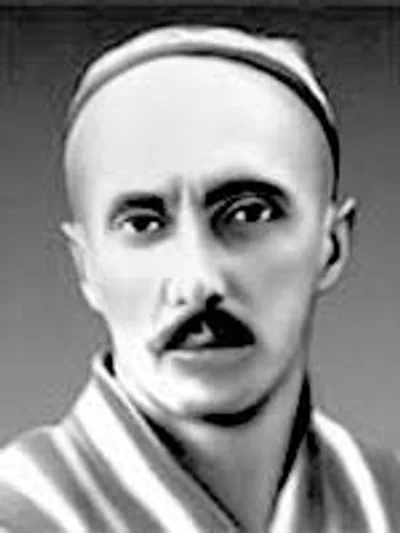
Hamza was born in Kokand in 1889 into a family of healers. He studied in traditional schools and madrasas before joining the Jadid movement, opening new-method schools in Tashkent, Kokand and Margilan and writing the textbooks for them. He wrote poetry, plays and songs, and is regarded as a founder of modern Uzbek drama and musical theatre; his work argued insistently for education, social justice and the position of women. Named People's Writer of Uzbekistan in 1926, he was killed at Shohimardon in 1929.
Childhood
Hamza Hakimzoda Niyoziy was born on 6 March 1889 in Kokand, into an educated family. His father, Ibn Yamin Niyoz oʻgʻli, was a physician, much respected among the scholars of Kokand and well versed in Uzbek, Arabic and Persian.
Education
Hamza began at a neighbourhood school, studied at the madrasas of Kokand from 1899 to 1906, and for a time learned Russian at a Russian-native school. The upheavals of the early twentieth century shaped him deeply: the revolutionary movements of 1905 stirred the peoples of the empire's distant regions to strive for enlightenment, freedom and independence. His interest in writing and the arts began in the 1900s.
In 1908, while studying in Namangan, he met the Tatar educator Abdulla Toʻqmullin. Hamza wrote in his autobiography that after Toʻqmullin saw more than a hundred pages of his writing in the old style, he took him in hand and began to teach and guide him. In 1909 he went to Bukhara to study Arabic with Muhammad Ikrom ibn Abdusalom, one of the city's progressive teachers and a supporter of Jadid schools, but the Shia–Sunni clashes there kept him from studying as he had planned.
Reading the Jadid press
Hamza's development as a writer owed much to Ismail Gasprinskiy's newspaper Tarjimon, Fotih Karimiy's Vaqt and Rizo Faxriddin's journal Shoʻro, and to the Uzbek-language papers of Tashkent: Ismoil Obidiy's Taraqqiy, Munavvarqori's Xurshid and Abdulla Avloniy's Shuhrat. He built ties with them, and his first poems and articles appeared in their pages.
He read Tarjimon regularly and knew Gasprinskiy's Mukolamai Salotin, serialised there in 1906–1907, which asked why the Turkic peoples, Turkestan's among them, had fallen under colonial rule.
Schools opened, schools closed
In 1910 Hamza began his practical work in Tashkent, opening his first new-method Jadid school in the Qashqar neighbourhood. He worked closely with Munavvarqori, leader of the Jadid movement in Turkestan, and with his students and fellow teachers, among them the brothers Shokirjon and Sobirjon Rahimiy and Samiʼqori. A document in Hamza's archive records the link and gives his address as the usuli savtiya school in the Mehrobod neighbourhood of Old Tashkent.
In 1911 he opened another school, in Kokand; under pressure from the tsarist authorities these schools were eventually closed. That same year he set out on the pilgrimage and travelled through Afghanistan, India, Turkey and Arabia, studying schools, upbringing and educational institutions wherever he went. On his return he gave more and more of himself to literature and the arts as well as teaching.
In 1914 he opened a school in Margilan and then another in Kokand. The Margilan school, he wrote, was forcibly closed by the local education authorities before it had run eight months. In Kokand he opened a free school for poor children; four months later the district authorities searched and closed it, but they found none of his papers, and Hamza escaped prison.
Textbooks and the Gʻayrat library
In these years Hamza wrote textbooks for the new schools: Yengil Adabiyot (Easy Literature), Oʻqish Kitobi (Reading Book) and Qiroat Kitobi (Book of Reading).
In 1915, with fellow educators in Kokand, he founded the Gʻayrat library, to publish textbooks for Jadid schools and to supply pupils with books printed in Tashkent and other cities. It held many copies of Saidrasul Saidazizov's Ustodi Avval, Munavvarqori's Adibi Avval and Adibi Soniy, and textbooks by Mahmudxoʻja Behbudiy and Abdulla Avloniy.
Nihoniy
Hamza began as a writer of traditional lyric poetry, under the pen name Nihoniy — “the hidden one”. Between 1905 and 1914 he gathered these poems into Devoni Nihoniy: 177 poems in all, 150 of them ghazals, the rest masnavis, murabbas, mukhammases, musaddases and one letter. Of these, 165 are in Uzbek, 10 in Persian-Tajik and 2 in the shiru-shakar style, mixing Uzbek and Russian.
Poems for national songs
A central place in his work belongs to the series Milliy Ashulalar Uchun Milliy Sheʼrlar Majmuasi (A Collection of National Poems for National Songs): seven collections of poems written between 1915 and 1917.
- Atir Gul (Scented Flower)
- Oq Gul (White Flower)
- Qizil Gul (Red Flower)
- Pushti Gul (Pink Flower)
- Sariq Gul (Yellow Flower)
- Yashil Gul (Green Flower)
- Safsar Gul (Purple Flower)
Their aim was to wake the people's social and political awareness and draw them toward knowledge. Like Abdulla Avloniy, Hamza kept the traditional melodies but replaced unworthy lyrics with words that carried the national spirit and the people's hope of independence; he understood that such ideas reach the heart faster through music and song than through print. The growth of the sharqiya genre in Uzbek literature is closely tied to Hamza and Avloniy, and his collections sit close to Avloniy's Adabiyot yoxud Milliy Sheʼrlar. Hamza was himself a gifted musician.
In one poem set to Khorezmian folk melodies, beginning “Good fortune has been lost by unfortunate Turkestan”, he mourned the economic, spiritual and political oppression of the colonised land. The collections were loved by readers and singers alike: an early scholar of Hamza, Sotti Husayn, noted that the songs spread beyond a small circle of readers to performers, and at the same time drew fierce opposition from reactionaries and clerics. Lines of his travelled to villages that had no school at all.
Journalist
Like many Uzbek writers, Hamza was shaped by Ismail Gasprinskiy and Tarjimon. When Gasprinskiy died on 11 September 1914, Hamza mourned him in Sadoyi Fargʻona with the article Yavmul-Vafot on 24 September and the poem Marsiya on 28 September.
The Safsar Gul collection described the hard, humiliating lives of Uzbek labourers taken far from their homeland; to speak out so openly against colonial oppression took real courage. In the articles Iydi Qurbon and Eʼtizor, in Sadoyi Turkiston and Sadoyi Fargʻona, he argued that only education could free the nation from harmful customs, poverty and superstition, and that rich and poor, intellectuals and clergy should unite behind the new-method schools. He opposed divisions of nation and class alike: only unity, he believed, could save the people from ignorance, backwardness and oppression. In Maktabi Dorul-Aytom he appealed for money so that poor and orphaned children could go to school.
A novel and a tragedy
Having learned his craft in the press and read widely in Turkish, Tatar and Russian literature, Hamza turned to prose, still new in Uzbek. In 1915 he published Yangi Saodat (New Happiness), which he called a “national novel”, lithographed by the Madura library. From 1915 he also wrote plays for the Kokand theatre troupe: first Zaharli Hayot yoxud Ishq Qurbonlari (Poisonous Life, or Victims of Love, 1915), then Oʻch (Revenge), Muxtoriyat yoki Avtonomiya (Autonomy, 1917), Kim Toʻgʻri? (Who Is Right?) and Boy ila Xizmatchi (The Rich Man and the Servant, 1918).
Both the novel and the first play are about the power of knowledge. In Yangi Saodat young Olimjon brings happiness, through learning, to Abdulqahhor's family, split apart by ignorance. In the play, ignorance and fanaticism drive two young champions of education, Mahmudxon and Maryamxon, to tragedy. This four-act tragedy was published in Tashkent in 1916 by the Gʻulomiya press, with Hamza's close friend Saidnosir Mirjalolov, a wealthy merchant and educator, as publisher; Hamza called it “the tragedy of a girl and a young man from the everyday life of Turkestan”.
Hamza was sometimes called an atheist because he exposed the misdeeds of certain clerics, but his target was fanaticism, not faith: Zaharli Hayot presents the Sharia as bound up with freedom, equality, justice and resistance to oppression. Soviet scholars read the play as class struggle, yet Mahmud is rich and Maryam desperately poor, and both fight for the nation's future regardless; Hamza judges his characters by their humanity, not their class.
Autonomy
His 1917 satirical play Muxtoriyat yoki Avtonomiya is the key to his politics. The February Revolution and the fall of the Romanovs raised Jadid hopes of independence. In March 1917 Munavvarqori and Abdulla Avloniy founded the Shoʻroyi Islom society, whose central council included Mahmudxoʻja Behbudiy, Mustafa Choqayev and Ubaydulla Xoʻjayev; later that year, as the Bolsheviks grew more active, conservative clerics broke away to form the Ulamo society.
Hamza built the play on a meeting of the Kokand branch of the Ulamo, a religious gathering where the young and the ulama quarrel over freedom for Turkestan — the young standing for the Jadids of Shoʻroyi Islom, the ulama for the traditionalists. Soviet scholars long presented the play as an attack on the Turkestan Autonomy; in fact it exposes the ignorance and narrow-mindedness of the Ulamo members who undermined the Jadids building that autonomy. The Ulamo persecuted him for it, and from October 1917 to 10 March 1918 he lived in hiding at the home of his friend Saidnosir Mirjalolov.
Hamza welcomed the proclamation of the Turkestan Autonomy on 27 November 1917 with the poem Turkiston Muxtoriyatina (To the Turkestan Autonomy), published in Ulugʻ Turkiston on 11 January 1918, congratulating the Muslim nation and calling on it to unite under one flag.
After the revolution
Before October 1917 the central idea of Hamza's work was enlightenment, and as one of the leading Jadid writers he worked in almost every literary form. Like other Jadids, he believed after the February Revolution that Turkestan had been freed from colonial rule. In 1917 he published the journals Kengash and then Hurriyat; in “Bugungi Qadrlik Kunlar” (These Precious Days), the leading article of Hurriyat's first issue, he greeted the revolution as a chance for freedom, equality and justice. But his outspoken criticism of colonialism did not please the Provisional Government or its local supporters, and both journals were closed.
After the October Revolution he wrote poems and songs in support of Soviet power. He did not see the new form of colonial policy the Bolsheviks were pursuing, and at times gave his talent to propaganda rather than art. Even so, his mid-1920s plays Paranji Sirlaridan Bir Lavha yoki Yallachilar Ishi (A Scene from the Secrets of the Paranji, or the Case of the Yallachis) and Burungi Qozilar yoki Maysaraning Ishi (The Judges of Old, or Maysara's Case) had a strong influence on Uzbek drama and theatre. On 27 February 1926 he was named People's Writer of Uzbekistan.
Shohimardon
In August 1928, on the instructions of the Soviet government, Hamza went to Shohimardon, a shrine village in the mountains of the Fergana Valley. There he threw himself into campaigns to strengthen government policy and against religious figures, including the campaign for women's unveiling — the most explosive ground in the region at that moment. On 18 March 1929 he was killed by a group of religious conservatives. He was forty years old.
Legacy
His death gave Soviet ideology grounds to read his whole work through the lens of class and party. He was cut off from his Jadid roots and presented instead as an opponent of the Jadids and as the sole founder of Uzbek Soviet literature and art; streets, a theatre and a district were named after him. The seventeen-part film Olovli Yoʻllar (Fiery Roads) is the most prominent example — and fictionalised portraits like it did more to damage than to deepen public respect for him.
Only after independence did his work begin to receive a balanced assessment. Without exaggeration, Hamza deserves a significant place among the great figures of twentieth-century Uzbek literature: an innovative poet, a perceptive prose writer, a gifted playwright, an energetic man of the theatre and a skilled teacher. Alongside Abdulla Avloniy, Abdurauf Fitrat and Abdulhamid Choʻlpon, he holds an important place in the history of Uzbek literature and of the Jadid movement.
Key achievements
- Regarded as a founder of modern Uzbek drama and musical theatre
- Opened new-method schools in Tashkent, Kokand and Margilan and wrote their textbooks
- Named People's Writer of Uzbekistan in 1926