
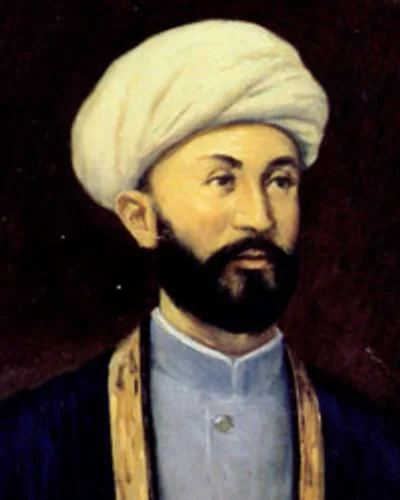
Born in 1862 at To'raqo'rg'on near Namangan, Ibrat studied in Kokand and then travelled unusually widely for his time — through Arabia, India and China — learning several languages on the way. He returned to open a new-method school, and in the early 1900s established Matbaai Ishoqiya, one of the first printing presses in the Fergana Valley. He wrote on language, history and culture, including a six-language dictionary, and served as a qazi. He was arrested during the purges and died in 1937.
Childhood
Is'hoqxon Ibrat was born in 1862 in the village of Toʻraqoʻrgʻon in the Namangan region. His ancestors came from the town of Turkestan and were held to be descendants of Ahmad Yasawi.
Both his parents were literate and taught at a school: his father, Junaydulla Xoʻja, son of Sunnatilla Xoʻja, and his mother, Hurbibi Otin. His father was a gardener by trade and wrote poetry under the pen name Xodim; his grandfather wrote as Afsus, and the poet Mulla Jamolxon Vasfiy (1862–1930) was his cousin.
Education
The old-style neighbourhood school did not work for him. He later wrote in Mezon uz-Zamon: “At the neighbourhood school I studied for five years under three teachers, and in the end I still could not read. Then I studied at the girls' school, in our own home, under my late mother, and became literate. For two years I practised fine handwriting under my father.”
In 1878 he entered the Muhammad Siddiq Tunqator madrasa in Kokand, where he came to know the poetry of Muqimiy, Furqat, Zavqiy, Haziniy and Nodim. On his own he read al-Farabi on the laws of the art of poetry, Nizami Aruzi Samarqandi's Rare Stories, Jami's Silsilat az-Zahab and Navoi's Nazm al-Javohir and Muhokamat al-Lugʻatayn. As a student he also followed the newspapers Turkestanskie Vedomosti, published in Uzbek and Russian, and Tarjimon.
A school with a new method
In 1886, his madrasa studies finished, Ibrat went home to Toʻraqoʻrgʻon and opened a school. Instead of the old syllable-by-syllable method, usuli qadim, he taught reading by the sounds of letters — the savtiya method.
The school was so unlike the others that officials of the Russian Empire in Namangan eventually forced it to close.
Travels
In 1887 he took his mother, Hurbibi, on the pilgrimage to Mecca. She died of pneumonia in Jeddah, and after burying her in one of the city's cemeteries he travelled on — to Istanbul, Sofia, Athens, Rome, Berlin and Paris — then returned to Mecca and sailed through the Red Sea and the Arabian Sea to India. He lived in Bombay from 1892 to 1896, and came home that year by way of Kashgar.
He brought back rare books and objects and showed them to the people of his village. The most precious was a manuscript of Yusuf Khass Hajib's Qutadgʻu Bilig, later known as the Namangan copy; in the 1930s Abdurauf Fitrat and Lutfulla Olimiy had it transferred to the Oriental department of the Tashkent library.
Judge and lexicographer
From 1898 Ibrat served as the people's judge of Toʻraqoʻrgʻon and was an active member of the Turkestan judges' congress. In 1901 he published Lugʻati Sitta al-Sina, the Six-Language Dictionary, covering Arabic, Persian, Hindi, Turkish, Uzbek and Russian; it served as a teaching aid in Jadid schools.
In 1907 Ismail Gasprinskiy wrote of his new school: “Is'hoqxon Toʻra opened the Is'hoqiya School in June in the town of Toʻraqoʻrgʻon, Namangan district. Fifty children were admitted. The school uses the sound method. There are day and evening classes: children study during the day, while adults come to a reading room in the evening. This school is a model for all the schools of the region.”
In 1908 he went to St Petersburg and Moscow to see their schools and educational institutions for himself.
The printing press
In Orenburg he bought a lithographic press on credit from a printer named Gafman, agreeing to pay for it over ten years. He took the machine and all its equipment by train to Kokand, and from Kokand to Toʻraqoʻrgʻon by camel.
In December 1908 he set it up in a bathhouse that had stood unused for years and named it Matbaa Is'hoqiya. His close friends Husayn Makaev and Abdulrauf Shahidiy helped him a great deal, and the newspapers Tarjimon and Vaqt greeted the opening with congratulatory articles.
The press began with primers and educational booklets. Its first publication, Sanʼati Ibrat, Qalami Mirrajab Bandiy, was used as an alphabet book in both Jadid and traditional schools across the Fergana Valley. From Russian cities Ibrat also brought home a cinematograph, photographic equipment, a gramophone and a refrigerator, and showed them to his neighbours.
Scholarly and literary legacy
Ibrat wrote more than fifteen scholarly and literary works, among them:
- Lugʻati Sitta al-Sina (The Six-Language Dictionary), 1901
- Fiqhiy Kaydoni Tarjimasi, 1908
- Jomeʼ ul-Xutut (Collection of Scripts), 1912
- Tarixi Fargʻona (History of Fergana), 1916
- Tarixi Madaniyat (History of Civilisation), 1917
- Mezon uz-Zamon (The Scales of Time), 1928
- Devoni Ibrat, his collected poems
At the end of Tarixi Madaniyat he listed his works, and several on that list have never been found: Gulshani Roz Turkiy, Tarjimai Holim, Tarixi Hurriyat, Qoʻrboshilar Zamoni, Mishkat ul-Gʻaroyib, Muzabzab, Turkistonda Turli Mashaqqatlar, Barzah, Tazkirai Suvaydo and Sayri Jibol. He also left unfinished works, including Ilmi Ibrat and Turli Marsiya va Fikriyot Masalalari.
Family
Ibrat had three sons: Abbaskhan, Rotifkhan and Vaqqaskhan. In 1919 Soviet soldiers suspected Abbaskhan, the eldest, of links with the “Basmachi” movement and beat him to death.
Arrest and death
In 1918 Ibrat's library was looted. On 7 January 1937 he was arrested, and the books, manuscripts and lithographs he had gathered over a lifetime were carried off in four sacks. His winter house and belongings were auctioned, and his family was driven from their home and left with three sotix of barren land.
Taken to the prison in Andijan, he died two months later, at 75, without ever being tried — unable to bear the conditions of his imprisonment. Where he is buried is not known.
Recognition
On 2 November 2016 President Shavkat Mirziyoyev spoke specifically about Ibrat's life and work at a meeting with voters in the Namangan region. On 13 April 2017 the Cabinet of Ministers resolved to create the Is'hoqxon Ibrat memorial complex in the Toʻraqoʻrgʻon district.
The complex now has a monument to Ibrat, a veranda in the national style, a printing house, a musical fountain, a 400-place boarding school specialising in foreign languages, a preschool and a museum of history and education.
Key achievements
- Founded Matbaai Ishoqiya, among the first printing presses in the Fergana Valley
- Compiled the Six-Language Dictionary (1901): Arabic, Persian, Hindi, Turkish, Uzbek and Russian
- Travelled through Europe, Arabia and India and brought home rare manuscripts, among them the Namangan copy of Qutadgʻu Bilig