
The full story
Munavvar Qori Abdurashidxonov
Pioneer of new-method schools in Tashkent
1878 – 1931
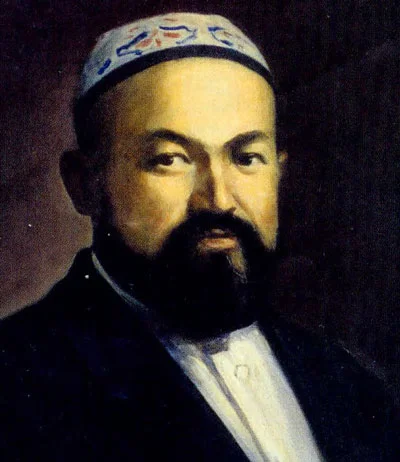
Born in Tashkent in 1878 into a lineage of educators, Munavvar Qori studied in both Tashkent and Bukhara and emerged as the chief architect of modern schooling across Turkestan. He opened one of the first new-method schools in Tashkent in 1901, wrote the textbooks it needed, and launched several newspapers that between them created a national press where none had existed. After 1917 he continued pressing for educational reform while holding official posts. Arrested in 1929, he was executed in Moscow in 1931.
Childhood
Munavvarqori Abdurashidxonov was born in 1878 in the Darxon neighbourhood of Tashkent's Shayx Xovandi Tohur district, into a family of teachers. His father, Abdurashidxon, had opened a school in the local Eshonquli dodxoh madrasa and in his own courtyard, where he taught about forty pupils; he died in 1885. His mother, Xosiyat otin (1845–1931), daughter of the well-known Tashkent scholar Xonxoʻja Shorahimxoʻjayev, taught the girls and women of the neighbourhood in her home.
Munavvar was the youngest of three sons. The eldest, Aʼzamxon (1872–1919), also taught; his 1910 request to open a new-method school — with a curriculum written by Munavvarqori — survives in the archives. The middle brother, Muslimxon (1875–1954), was a teacher and then imam of the neighbourhood mosque; after the mosques were closed he worked as a watchman, and in 1942 he was arrested and held for most of a year before being released for lack of evidence.
Education
His first teacher was his mother. After learning to read and write he studied with the well-known teacher Usmon domla, memorised the Quran — earning the title qori — and spent several years at the Yunusxon podsho madrasa. In 1898 he went to Bukhara to study hadith, law and Quranic commentary, but the Bukharan madrasas were under the eye of the imperial government's representative and could not give him the learning he wanted, so he left.
The new-method schools
In 1901 Munavvarqori opened the first new-method school in Tashkent. At first he used programmes and books from Crimean and Tatar teachers, but by 1907 he had written his own primer, Adibi avval — one of the first alphabets of the Uzbek language — followed the same year by a second reader, Adib as-soniy. Teachers across Turkestan adopted them; archival records show they were even allowed in the Russian-native schools, and by 1910–1911 teachers in Tashkent, Kokand, Namangan and Fergana were using them.
By 1912 his school openly taught calligraphy, geography, Islamic history and the history of the Turkic peoples. He was the first local teacher to set up a model school, Namuna, and asked the government to allow Russian to be taught; when it refused, he introduced Russian lessons in his own school anyway. By 1914–1916 most schools in Turkestan followed his programme.
In 1916 he took a group of children to Governor-General Kuropatkin to ask for more freedom for the new schools, while his pupil, the young poet Toʻgʻrul, recited a poem in the governor's honour at the door. Munavvarqori was arrested for it, though soon released. In September 1917 he proposed turning the Russian-native schools into national Muslim schools and submitted a six-year curriculum for them.
Education beyond the classroom
He worked just as hard to send young people abroad to study. On 24 September 1917 some fifty or sixty Tashkent intellectuals and merchants gathered at his house and pooled money for scholarships; the Nashri maorif society helped students too, and under Soviet rule he helped create the Koʻmak society for the same purpose.
In 1909, with Ubaydulla Xoʻjayev, Abdulla Avloniy, Toshpoʻlatbek Norboʻtabekov and others, he founded the Jamiyati xayriya (Charitable Society); as its deputy chairman he gradually brought it into the hands of the progressive young. In April 1918 a meeting of Muslim organisations in his courtyard decided to open a Muslim branch of the People's University in Tashkent, and elected him chairman of the organising commission. He examined its teachers with Burhon Habib, set up an eight-month teacher-training course, the Dorilmuallimin, which opened on 31 May 1918, and with Shorasul Zunnun and Qayum Ramazon wrote the four-part Oʻzbekcha til saboqligʻi — one of the foundations of Uzbek grammar.
The press
The Uzbek national press is hard to imagine without him. In 1906 he wrote for Oʻrta Osiyoning umrguzorligi and Taraqqiy, and founded his own newspaper, Xurshid, as publisher and editor. Its spirit alarmed the Tsarist administration and it was soon closed; the secret police began to analyse every book, sermon and article he wrote. He then guided and wrote for Shuhrat (1907), Tujjor (1907) and Osiyo (1908).
In February 1908 the orientalist Nikolay Ostroumov sent the Governor-General a secret letter calling him a “half-educated scholar” and advising that Shuhrat be closed, not least because Munavvarqori used Turkish and Tatar words such as afandi. With Ubaydulla Xoʻjayev he founded Sadoyi Turkiston (1914–1915), whose staff included Avloniy, Tavallo, Choʻlpon and Mirmuhsin. From 1915 he ran the religious journal Al-isloh, which used hadith and Quranic verses to argue for independence. After the February Revolution he took the government newspaper out of Ostroumov's hands, renamed it Najot, and later edited Kengash, which helped prepare the Turkestan Autonomy, in turn with Zaki Validi.
Theatre
Munavvarqori was one of the organisers of the Turon society and its theatre troupe, which gave its first unofficial performance in the summer of 1913. On 27 February 1914 he formally opened the first season of the Uzbek national theatre at the Coliseum in Tashkent. He understood drama deeply, and became a mentor in it to Hamza Hakimzoda Niyoziy.
Politics and the struggle for autonomy
After 1917 he led the political organisation Shoʻroi Islomiya, later the Turkiston Shoʻroi Islomiya jamiyati, with Ubaydulla Xoʻjayev as chairman and himself as deputy — and, since Xoʻjayev was often travelling, did most of the work. He built ties with the Kazakh Alash party, the Tatar and Bashkir societies of Central Russia and the organisations of Turkestan and Bukhara. He helped found the Turkestan Autonomy in Kokand, was elected to its board and defended it at a meeting in Tashkent in December 1917.
After the autonomy was crushed he led the underground organisations Milliy ittihod and Milliy istiqlol, which fought for the independence of the Uzbek lands. With their approval he and many comrades took posts in the Soviet institutions of the Turkestan republic: he worked in the People's Commissariat of Education and as head of its waqf department, which let him travel to every city and large village and organise the secret network. Thanks to this, almost every city of Turkestan was represented at the Congress of the Peoples of the East in Baku in September 1920, where he sat on the board.
The “national delimitation” of 1924 ended those hopes; without military or economic strength the organisation fell apart. He and his comrades turned instead to exposing colonial policy in the foreign press, sending the Uzbek and Russian press to Mustafa Choʻqay in Paris, and even trying to send an envoy to England.
Last years of freedom
In the late 1920s every step he took was watched, and people who had once respected him turned away, whether from ambition or fear of the political police. With no work allowed him, he sold his house and went to Moscow hoping to study at the Committee for the Study of the Peoples of the East; Akmal Ikromov promised help and sent him back to Tashkent, but no help came. He taught for a time in 1927 until he was dismissed on the old suspicions, and afterwards made a living by sewing and selling gloves.
Writings
His textbooks were reprinted many times:
- Adibi avval (1907)
- Adib as-soniy (1907)
- Usuli hisob (arithmetic)
- Tarixi qavm turk (a history of the Turks)
- Tajvid (1911)
- Havoyiji diniya
- Tarixi anbiyo (a history of the prophets)
- Tarixi islomiya (1912)
- Yer yuzi (geography, 1916–1917)
- Oʻzbekcha til saboqligʻi, in four parts, with Shorasul Zunnun and Qayum Ramazon (1925–1926; the fourth part was confiscated)
In 1914 he compiled Sabzavor, an anthology of progressive Uzbek poets. He also wrote stories — among them “Bizda hamiyat”, “Tugʻishganlik sevgisi”, “Devpechak” and “Qullikka qanday tushdi?” — and poems such as “Yalqovlik yovimizdir” and “Har kim ekkanini oʻrar”, some under the pen name Muharram.
Family
In his memoirs he mentions a wife and a daughter. His daughter and grandchild died in 1926, and when he left for Moscow he separated from his wife; the sources do not give their names. He is also said to have adopted his brother Muslimxon's son, Muhammad.
Arrest and death
In September 1929 he was finally granted a pension; it is not known whether he ever received any of it. On 6 November 1929 he was arrested, his house was searched and all his papers and books were burned in the courtyard. For three months he and his comrades refused to sign the interrogation records, until the head of the political police's Eastern Department and his officers broke them with non-stop interrogations, solitary cells and deprivation.
“I am now seriously ill,” he wrote in October 1930. “My legs are so swollen that I cannot walk without help. I ask to be moved to a common cell or to a hospital.” He received no answer. After seven months in solitary confinement without daylight, Munavvarqori Abdurashidxonov was shot on 23 April 1931.
Key achievements
- Opened one of Tashkent's first new-method schools in 1901 and trained a generation of teachers
- Wrote foundational Uzbek textbooks, including primers still cited in the history of Uzbek pedagogy
- Founded and edited newspapers that established a Turkestani national press